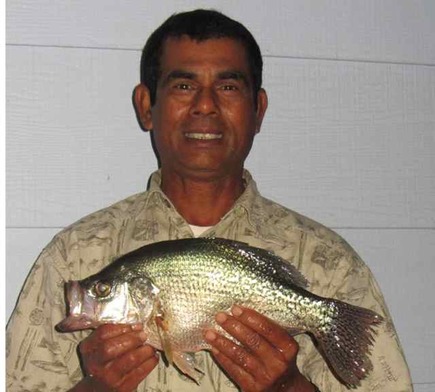
Body Type & Identification: Silver-white with dark vertical bars arranged in a regular pattern — more regular and bar-like than the random spots of Black Crappie. Five or six dorsal spines (Black Crappie has seven or eight). Tolerates more turbid and warmer water than Black Crappie. The most adaptable and widespread crappie species.
Preferred Water Temperature: 65°F–76°F. Spawn in spring at 62°F–68°F in shallow areas near brush or timber. Form large, accessible spawning aggregations — excellent spring fishing. Can tolerate warmer, more turbid conditions than Black Crappie.
Habitat: Lakes, reservoirs, ponds, and rivers throughout the eastern US — found in more varied water conditions than Black Crappie. Associate with submerged timber, dock pilings, and brush. Particularly abundant in turbid Southern reservoirs and river systems. The dominant crappie species in many river-reservoir systems.
Best Lures: Small tube jigs (1/16–1/8 oz) in chartreuse, white, and pink are the standard. Small Beetle Spins work very well. Tiny swimbaits on light jigheads. Crappie magnets and Bobby Garland Baby Shad are popular. Spider rigging multiple rods around brush piles covers water effectively.
Best Baits: Small live minnows under a slip float are the premier natural bait. Small wax worms work in cooler water. Small nightcrawler pieces produce results. Light 4–8 lb line with small hooks and a float set at the depth fish are holding is the classic approach.
Top 5 Destinations: Grenada Lake MS, Weiss Lake AL, Rough River Lake KY, Reelfoot Lake TN, Chickamauga Lake TN.
Silver-white with dark vertical bars arranged in a regular pattern — more regular and bar-like than the random spots of Black Crappie. Five or six dorsal spines (Black Crappie has seven or eight). Tolerates more turbid and warmer water than Black Crappie. The most adaptable and widespread crappie species.
Habitat
4 of 9
Lakes, reservoirs, ponds, and rivers throughout the eastern US — found in more varied water conditions than Black Crappie. Associate with submerged timber, dock pilings, and brush. Particularly abundant in turbid Southern reservoirs and river systems. The dominant crappie species in many river-reservoir systems.
Water Conditions
5 of 9
65°F–76°F. Spawn in spring at 62°F–68°F in shallow areas near brush or timber. Form large, accessible spawning aggregations — excellent spring fishing. Can tolerate warmer, more turbid conditions than Black Crappie.
Tackle & Bait
6 of 9
Best Lures:
Small tube jigs (1/16–1/8 oz) in chartreuse, white, and pink are the standard. Small Beetle Spins work very well. Tiny swimbaits on light jigheads. Crappie magnets and Bobby Garland Baby Shad are popular. Spider rigging multiple rods around brush piles covers water effectively.
Best Baits:
Small live minnows under a slip float are the premier natural bait. Small wax worms work in cooler water. Small nightcrawler pieces produce results. Light 4–8 lb line with small hooks and a float set at the depth fish are holding is the classic approach.
Top Fishing Locations
7 of 9
Filter by State:
60 fishing locations where you can catch White Crappie