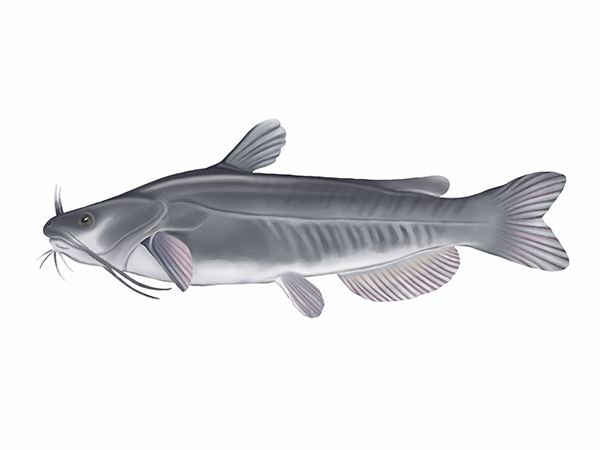
Body Type & Identification: Stocky, rounded body — more compact than Channel or Blue Catfish. Moderately forked tail. Chin barbels are white (hence the name). Smaller than Channel and Blue Catfish — an ideal pond and smaller water catfish. Native to Atlantic coastal drainages from New Jersey to Florida.
Preferred Water Temperature: 68°F–82°F. Tolerates a wide range of water conditions including slightly brackish water — more tolerant of poor water quality than other catfish. Spawn in late spring when water reaches 70°F in hollows, undercut banks, and enclosed spaces.
Habitat: Rivers, ponds, and lakes of the Atlantic coastal plain and widely introduced in California (Sacramento-San Joaquin Delta) and other western states. Prefers slow to moderate current with muddy or sandy bottom. Very common in the California Delta where large populations exist.
Best Lures: Rarely taken on artificial lures. Occasional catches on scented soft plastics.
Best Baits: Nightcrawlers are the most effective natural bait. Fresh cut fish work well. Chicken liver produces results. Clams are excellent in tidal areas. Dip baits and stink baits work throughout the season. Light to medium tackle with bottom rigs near structure.
Top 5 Destinations: Sacramento-San Joaquin Delta CA, Chesapeake Bay tributaries MD/VA, Delaware River, Lake Mead NV, Santee Cooper SC.
Stocky, rounded body — more compact than Channel or Blue Catfish. Moderately forked tail. Chin barbels are white (hence the name). Smaller than Channel and Blue Catfish — an ideal pond and smaller water catfish. Native to Atlantic coastal drainages from New Jersey to Florida.
Habitat
4 of 8
Rivers, ponds, and lakes of the Atlantic coastal plain and widely introduced in California (Sacramento-San Joaquin Delta) and other western states. Prefers slow to moderate current with muddy or sandy bottom. Very common in the California Delta where large populations exist.
Water Conditions
5 of 8
68°F–82°F. Tolerates a wide range of water conditions including slightly brackish water — more tolerant of poor water quality than other catfish. Spawn in late spring when water reaches 70°F in hollows, undercut banks, and enclosed spaces.
Tackle & Bait
6 of 8
Best Lures:
Rarely taken on artificial lures. Occasional catches on scented soft plastics.
Best Baits:
Nightcrawlers are the most effective natural bait. Fresh cut fish work well. Chicken liver produces results. Clams are excellent in tidal areas. Dip baits and stink baits work throughout the season. Light to medium tackle with bottom rigs near structure.
Top Fishing Locations
7 of 8
Filter by State:
60 fishing locations where you can catch White Catfish