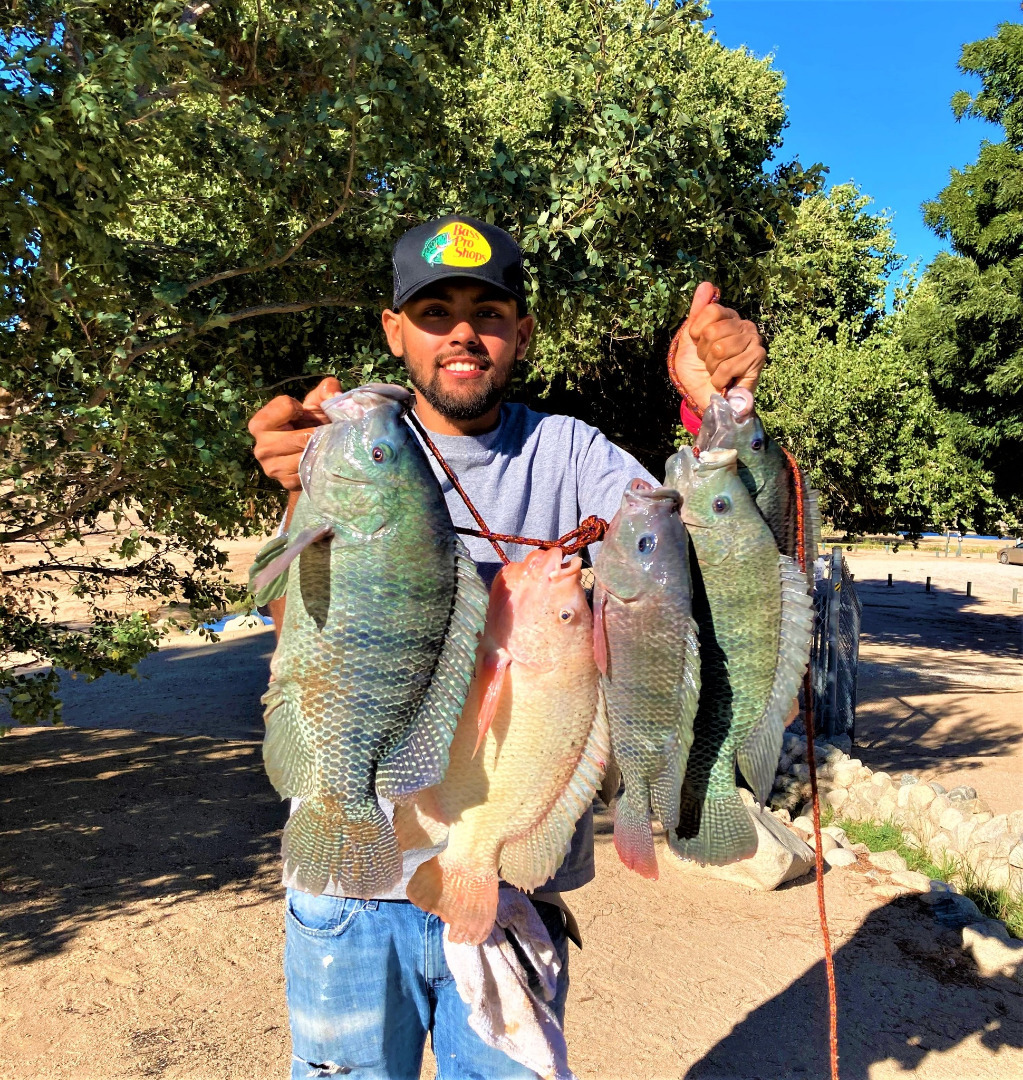
Body Type & Identification: Deep-bodied cichlid with a long dorsal fin and large scales. Olive to gray with faint vertical bars — coloring varies by species (several Tilapia species have been introduced in the US). Originally from Africa and the Middle East, now widely established in Florida, Texas, Arizona, and California. One of the most abundant freshwater fish in South Florida.
Preferred Water Temperature: 72°F–90°F. A warm-water species that dies when temperatures drop below 50°F — this limits their expansion in the US. Thrives in the warm, year-round waters of South Florida, the Rio Grande, and the Colorado River system in Arizona and California.
Habitat: Canals, ponds, lakes, and slow rivers of South Florida, Texas, Arizona, and Southern California. Extremely adaptable — tolerates brackish water, high salinity, low oxygen, and thermal effluent. Often the dominant fish in urban South Florida canals alongside Peacock Bass. An important subsistence fish in some areas — excellent eating.
Best Lures: Small jigs and soft plastics produce strikes. Small spinners work near vegetation. Fly fishing with small soft-hackle flies produces excellent results — Tilapia are surprisingly responsive to flies. Small popping bugs work near surface-feeding fish.
Best Baits: Bread balls are a classic and highly effective Tilapia bait. Corn produces excellent results. Worms work well. Cooked pasta and cooked vegetable matter are effective — Tilapia are partly herbivorous. Small pieces of fresh bait catch fish near structure. Light tackle with small hooks and plant-based baits near vegetation.
Top 5 Destinations: South Florida canals (Miami-Dade, Broward) FL, Rio Grande TX, Colorado River AZ, Imperial Valley canals CA, Lake Havasu AZ.
Deep-bodied cichlid with a long dorsal fin and large scales. Olive to gray with faint vertical bars — coloring varies by species (several Tilapia species have been introduced in the US). Originally from Africa and the Middle East, now widely established in Florida, Texas, Arizona, and California. One of the most abundant freshwater fish in South Florida.
Habitat
4 of 9
Canals, ponds, lakes, and slow rivers of South Florida, Texas, Arizona, and Southern California. Extremely adaptable — tolerates brackish water, high salinity, low oxygen, and thermal effluent. Often the dominant fish in urban South Florida canals alongside Peacock Bass. An important subsistence fish in some areas — excellent eating.
Water Conditions
5 of 9
72°F–90°F. A warm-water species that dies when temperatures drop below 50°F — this limits their expansion in the US. Thrives in the warm, year-round waters of South Florida, the Rio Grande, and the Colorado River system in Arizona and California.
Tackle & Bait
6 of 9
Best Lures:
Small jigs and soft plastics produce strikes. Small spinners work near vegetation. Fly fishing with small soft-hackle flies produces excellent results — Tilapia are surprisingly responsive to flies. Small popping bugs work near surface-feeding fish.
Best Baits:
Bread balls are a classic and highly effective Tilapia bait. Corn produces excellent results. Worms work well. Cooked pasta and cooked vegetable matter are effective — Tilapia are partly herbivorous. Small pieces of fresh bait catch fish near structure. Light tackle with small hooks and plant-based baits near vegetation.