Green Sturgeon
Acipenser medirostris
Family / Type
Acipenseridae
Habitat
Anadromous
Scientific Name
Acipenser medirostris
Family
Acipenseridae
Order
Acipenseriformes
Class
Actinopterygii
Ocean
Pacific Ocean
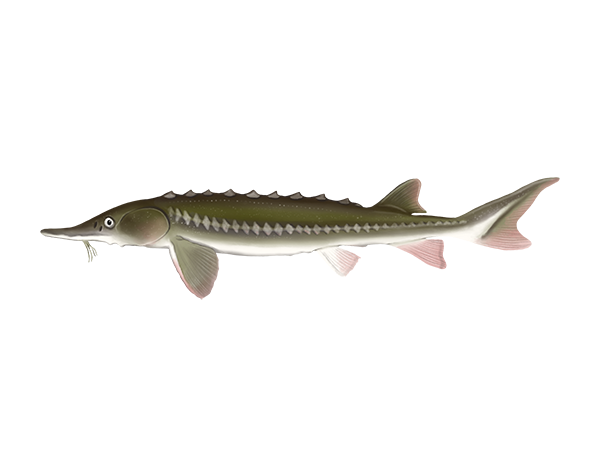
Artwork: © SportfishingReport.com Inc
Full Taxonomy
Animalia
› Chordata
› Actinopterygii
› Acipenseriformes
› Acipenseridae
› Acipenser
› Acipenser medirostris
Overview
1 of 7
Weight: up to 350 pounds (160 kg)
Length: average 4.5-6.5 feet (1.5-2 m), can be as long at 7 feet
Appearance: they have no scales, but they have five rows of characteristic bony plates on their body called "scutes"
Lifespan: 60-70 years
Diet: shrimp, mollusks, amphipods, and small fish
Behavior: anadromous; they live primarily in the sea and breed in fresh water
Green sturgeon are long-lived, slow-growing fish and the most marine-oriented of the sturgeon species. Mature males range from 4.5-6.5 feet (1.4-2 m) in "fork length" and do not mature until they are at least 15 years old (Van Eenennaam, 2002), while mature females range from 5-7 feet (1.6-2.2 m) fork length and do not mature until they are at least 17 years old. They can weigh up to 350 pounds (160 kg). Maximum ages of adult green sturgeon are likely to range from 60-70 years (Moyle, 2002).
Although they are members of the class of bony fishes, the skeleton of sturgeons is composed mostly of cartilage. Sturgeon lack scales; however, they have five rows of characteristic bony plates on their body called "scutes". The backbone of the sturgeon curves upward into the caudal fin, forming their shark-like tail. On the ventral, or underside, of their flattened snouts are sensory barbels and a siphon-shaped, protrusible, toothless mouth. Recent genetic information suggests that green sturgeon in North America are taxonomically distinct from morphologically similar forms in Asia.
Green sturgeon are believed to spend the majority of their lives in nearshore oceanic waters, bays, and estuaries. Early life-history stages reside in fresh water, with adults returning to freshwater to spawn when they are more than 15 years of age and more than 4 feet (1.3 m) in size. Spawning is believed to occur every 2-5 years (Moyle, 2002). Adults typically migrate into fresh water beginning in late February; spawning occurs from March-July, with peak activity from April-June (Moyle et al., 1995). Females produce 60,000-140,000 eggs (Moyle et al., 1992). Juvenile green sturgeon spend 1-4 years in fresh and estuarine waters before dispersal to saltwater (Beamsesderfer and Webb, 2002). They disperse widely in the ocean after their out-migration from freshwater (Moyle et al., 1992).
The only feeding data we have on adult green sturgeon shows that they are eating "benthic" invertebrates including shrimp, mollusks, amphipods, and even small fish (Moyle et al., 1992).
Habitat
Green sturgeon utilize both freshwater and saltwater habitat. Green sturgeon spawn in deep pools or "holes" in large, turbulent, freshwater river mainstems (Moyle et al., 1992). Specific spawning habitat preferences are unclear, but eggs likely are broadcast over large cobble substrates, but range from clean sand to bedrock substrates as well (Moyle et al., 1995). It is likely that cold, clean water is important for proper embryonic development.
Adults live in oceanic waters, bays, and estuaries when not spawning. Green sturgeon are known to forage in estuaries and bays ranging from San Francisco Bay to British Columbia.
In October 2009, NMFS designated critical habitat for the Southern DPS.
Distribution
This species is found along the west coast of Mexico, the United States, and Canada. Green sturgeon are the most broadly distributed, wide-ranging, and most marine-oriented species of the sturgeon family. The green sturgeon ranges from Mexico to at least Alaska in marine waters, and is observed in bays and estuaries up and down the west coast of North America (Moyle et al., 1995).
The actual historical and current distribution of where this species spawns is unclear as green sturgeon make non-spawning movements into coastal lagoons and bays in the late summer to fall, and because their original spawning distribution may have been reduced due to harvest and other anthropogenic effects (Adams et al., in press). Today green sturgeon are believed to spawn in the Rogue River, Klamath River Basin, and the Sacramento River. Spawning appears to rarely occur in the Umpqua River. Green sturgeon in the South Fork of the Trinity River were thought extirpated (Moyle, 2002), but juveniles are captured at Willow Creek on the Trinity River (Scheiff et al., 2001), and it is suspected that the fish could be coming from either the South Fork or the Trinity River (Adams et al., in press). Green sturgeon appear to occasionally occupy the Eel River.
Population Trends
No good data on current population sizes exists and data on population trends is lacking.
Threats The principal factor in the decline of the Southern DPS is:
The reduction of the spawning area to a limited section of the Sacramento.
Other threats to the Southern DPS include:
Insufficient freshwater flow rates in spawning areas, contaminants (e.g., pesticides)
Bycatch of green sturgeon in fisheries
Potential poaching (e.g., for caviar)
Entrainment by water projects
Influence of exotic species
Small population size
Impassable barriers
Elevated water temperatures
Conservation Efforts
Fishing regulations and conservation measures represent a reduction in risk to green sturgeon. California, Oregon, Washington (United States) and British Columbia (Canada) have restricted commercial and sport fisheries where green sturgeon occur (IUCN Red List of Threatened Species This link is an external site.). Recent implementation of sturgeon fishing restrictions in Oregon and Washington and protective efforts put in place on the Klamath, Trinity, and Eel Rivers in the 1970s, 1980s, and 1990s may offer protection to the Southern DPS. The recent closure of the California recreational fishery may also provide beneficial to this species. The most important conservation currently occurring is the change in operations of Red Bluff Diversion dam (open from mid September to mid May) allowing access to spawning areas above the dam. Originally, the dam was closed year around.
Regulatory Overview
After completion of a study of its status (Adams et al., 2002) in 2002, NMFS determined that the green sturgeon is comprised of two DPSs that qualify as species under the ESA, but that neither warranted listing as threatened or endangered [pdf] (68 FR 4433). Uncertainties in the structure and status of both DPSs led NMFS to add them to the Species of Concern List [pdf] (69 FR 19975).
The "not warranted" determination was challenged on April 7, 2003. NMFS produced an updated status review on February 22, 2005 and reaffirmed that the northern green sturgeon DPS only warranted listing on the Species of Concern List, however proposed that the Southern DPS should be listed as threatened under the ESA. NMFS published a final rule on April 7, 2006 listing the Southern DPS as threatened [pdf] (71 FR 17757), which took effect June 6, 2006.
In September 2008, NMFS proposed critical habitat for the Southern DPS [pdf]. The public comment period was extended for the proposed critical habitat.
On May 21, 2009, NMFS proposed a 4(d) rule to apply ESA take prohibitions to the Southern DPS. NMFS published the final 4(d) rule in June 2010.
Identifying
3 of 7
Habitat
4 of 7
Water Conditions
5 of 7
Tackle & Bait
6 of 7
Top Fishing Locations
7 of 7
2 fishing locations where you can catch Green Sturgeon
Sacramento River
🏞️ Freshwater
CA
San Francisco Bay
🏞️ Freshwater
San Francisco, CA