Greater Amberjack
Seriola dumerili
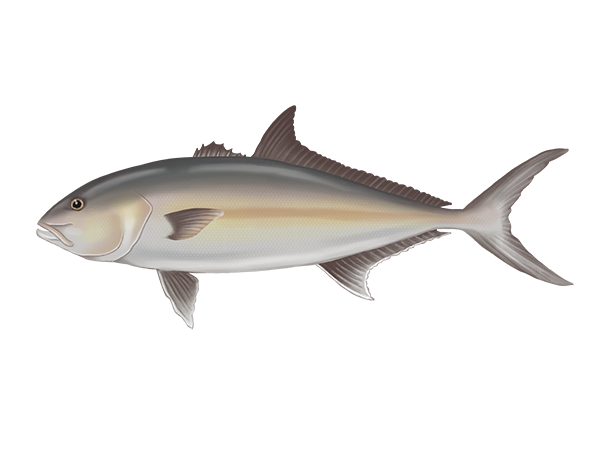
Artwork: © SportfishingReport.com Inc
Overview
Oceans & Range: Atlantic Ocean, Mediterranean Sea, and Indo-Pacific. In the Western Atlantic, found from Nova Scotia south through Florida, the Gulf of Mexico, and Caribbean. In the Pacific and Indo-Pacific, a closely related species ranges from Hawaii to Australia. The largest of the amberjack family — commonly found around offshore wrecks, reefs, buoys, and oil platforms in 60–240 feet of water.
Preferred Water Temperature: 65°F–82°F. An offshore structure fish found around rocky reefs, ledges, wrecks, and buoys. Concentrates at the thermocline depth in summer and moves shallower in cooler months.
Size & Weight: Typically 15–60 lbs and 3–5 feet. Trophy fish exceed 100 lbs. World record: 155 lbs 10 oz from the Canary Islands. Known as the "reef donkey" — pound-for-pound one of the strongest pulling fish in the ocean. A tough, dogged fighter that immediately dives for structure when hooked.
Best Lures: Large vertical jigs (4–8 oz) in silver, blue, and sardine patterns are the dominant technique — dropped to structure and jigged aggressively. Large swimbaits and paddle tails produce strikes near structure. Topwater poppers work on surface-feeding fish at dawn. Large spoons produce when fish are chasing bait.
Best Baits: Live blue runners are the top live bait — pin them through the nose on a heavy circle hook near structure. Large live pogies (menhaden) produce trophy fish. Live pinfish work well around Gulf platforms. Fresh cut bonito chunks dropped to structure are very effective. Large live or dead cigar minnows are excellent.
Identifying
Water Conditions
Tackle & Bait
Size & Sport
Whoppers — Biggest Catches
.png)