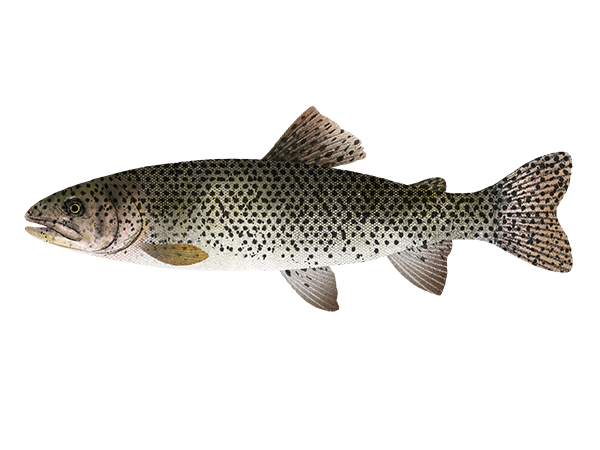
Body Type: A medium-sized trout with the distinctive red-orange slash marks under the jaw that give all Cutthroat Trout their name. The Coastal variety is heavily spotted with dark spots across the entire body including below the lateral line. Body color ranges from silvery in sea-run fish to golden-olive in resident stream fish.
Preferred Water Temperature: 50°F–62°F. Highly adapted to the cool, rain-fed coastal streams of the Pacific Northwest. Sea-run fish tolerate brackish estuary water over a wide temperature range.
Habitat: Coastal streams, estuaries, tidal flats, and saltwater beaches from Northern California to Alaska. Resident fish hold in clear, cool streams under log jams, in pools, and along cut banks. Sea-run (anadromous) fish roam saltwater beaches and estuaries before entering streams. A unique fish that can be caught wading saltwater beaches.
Best Lures: Small inline spinners in gold or silver are highly effective. Small spoons work in streams and estuaries. Small Rapala minnow lures produce in larger pools and saltwater. Fly fishing with small streamers, wet flies, and dry flies on size 10–14 hooks is the premier approach. Small soft plastics and tube jigs work in tidal water.
Best Baits: Nightcrawlers and earthworms produce consistent results. Salmon eggs work in streams, especially near spawning salmon. Small shrimp are effective in saltwater and estuaries. Small live minnows produce larger fish. Grasshoppers and crickets work in summer.
Size & Weight: Stream residents typically run 8–14 inches. Sea-run fish commonly reach 16–20 inches and 2–4 lbs. World record Coastal Cutthroat: 12 lbs from Salmon River, Idaho.
Top 5 Places to Catch Coastal Cutthroat:
1. Puget Sound beaches, Washington — unique saltwater beach fishing
2. Oregon coastal streams — numerous productive small rivers
3. Willapa Bay tributaries, Washington — outstanding sea-run fishery
4. Tillamook Bay, Oregon — excellent estuary and river fishing
5. Southeast Alaska coastal streams — wild and remote sea-run fishing
A medium-sized trout with the distinctive red-orange slash marks under the jaw that give all Cutthroat Trout their name. The Coastal variety is heavily spotted with dark spots across the entire body including below the lateral line. Body color ranges from silvery in sea-run fish to golden-olive in resident stream fish.
Habitat
4 of 10
Coastal streams, estuaries, tidal flats, and saltwater beaches from Northern California to Alaska. Resident fish hold in clear, cool streams under log jams, in pools, and along cut banks. Sea-run (anadromous) fish roam saltwater beaches and estuaries before entering streams. A unique fish that can be caught wading saltwater beaches.
Water Conditions
5 of 10
50°F–62°F. Highly adapted to the cool, rain-fed coastal streams of the Pacific Northwest. Sea-run fish tolerate brackish estuary water over a wide temperature range.
Tackle & Bait
6 of 10
Best Lures:
Small inline spinners in gold or silver are highly effective. Small spoons work in streams and estuaries. Small Rapala minnow lures produce in larger pools and saltwater. Fly fishing with small streamers, wet flies, and dry flies on size 10–14 hooks is the premier approach. Small soft plastics and tube jigs work in tidal water.
Best Baits:
Nightcrawlers and earthworms produce consistent results. Salmon eggs work in streams, especially near spawning salmon. Small shrimp are effective in saltwater and estuaries. Small live minnows produce larger fish. Grasshoppers and crickets work in summer.
Top Fishing Locations
7 of 10
Filter by State:
60 fishing locations where you can catch Coastal Cutthroat
1. Puget Sound beaches, Washington — unique saltwater beach fishing
2. Oregon coastal streams — numerous productive small rivers
3. Willapa Bay tributaries, Washington — outstanding sea-run fishery
4. Tillamook Bay, Oregon — excellent estuary and river fishing
5. Southeast Alaska coastal streams — wild and remote sea-run fishing
Size & Sport
8 of 10
Stream residents typically run 8–14 inches. Sea-run fish commonly reach 16–20 inches and 2–4 lbs. World record Coastal Cutthroat: 12 lbs from Salmon River, Idaho.
Whoppers — Biggest Catches
9 of 10
🥇
3.50 lbs
Mike Williams
June Lake Loop, June Lake, CAApr 27, 2019
State & Agency Records
10 of 10
1 official record on file for Coastal Cutthroat
🥇
9 lbs. 8 oz.
Phillip Grove
Malheur River, Vale, ORJan 1, 1986Freshwater AnglingODFW