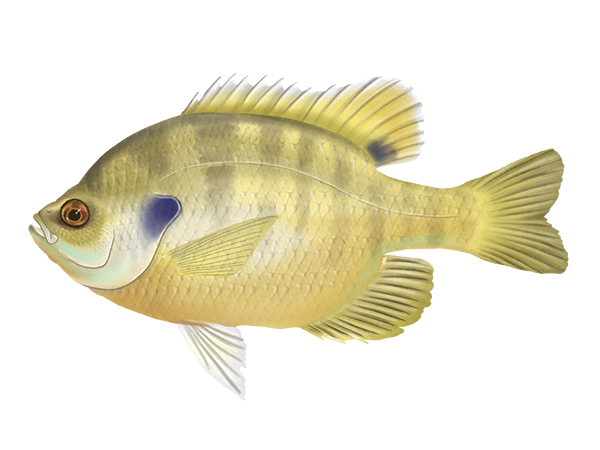
Body Type & Identification: Deep, laterally compressed body with a distinctive dark "ear" flap and blue-purple iridescence on the gill cover. Olive to orange-brown with dark vertical bars. A small black spot at the base of the soft dorsal fin. The most beloved panfish in America — the fish that introduces millions of Americans to fishing each year.
Preferred Water Temperature: 65°F–80°F. Most active and aggressive at 70°F–75°F. Spawn in large, visible colonies in shallow gravel or sand areas in late spring and early summer — the beds are clearly visible as light-colored circular depressions in the bottom and the fish aggressively defend them.
Habitat: Found in virtually every pond, lake, reservoir, and slow river in the eastern US — the most widely distributed of all North American sunfish. Associate with aquatic vegetation, dock pilings, submerged brush, and rocky shorelines. The ecological foundation of warm-water fishing — primary prey for Largemouth Bass.
Best Lures: Small poppers and dry flies on fly tackle produce spectacular surface strikes during the spawn. Small Beetle Spins are outstanding. Tiny tube jigs under 1/16 oz. Small inline spinners work well. Nearly any small lure produces catches from actively feeding fish. Fly fishing with a 3–5 weight rod and small poppers or woolly buggers is one of the most enjoyable fishing experiences available.
Best Baits: Red worms and small pieces of nightcrawler are the classic bait — a small piece of worm on a #8 hook under a bobber is how most Americans learn to fish. Crickets are outstanding in summer. Wax worms work in cooler water. Meal worms produce well. Small pieces of bread work in a pinch. Any small live bait under a float near structure catches Bluegill consistently.
Top 5 Destinations: Lake Okeechobee FL, Reelfoot Lake TN, Lake Fork TX, Guntersville Lake AL, Weiss Lake AL.
Deep, laterally compressed body with a distinctive dark "ear" flap and blue-purple iridescence on the gill cover. Olive to orange-brown with dark vertical bars. A small black spot at the base of the soft dorsal fin. The most beloved panfish in America — the fish that introduces millions of Americans to fishing each year.
Habitat
4 of 9
Found in virtually every pond, lake, reservoir, and slow river in the eastern US — the most widely distributed of all North American sunfish. Associate with aquatic vegetation, dock pilings, submerged brush, and rocky shorelines. The ecological foundation of warm-water fishing — primary prey for Largemouth Bass.
Water Conditions
5 of 9
65°F–80°F. Most active and aggressive at 70°F–75°F. Spawn in large, visible colonies in shallow gravel or sand areas in late spring and early summer — the beds are clearly visible as light-colored circular depressions in the bottom and the fish aggressively defend them.
Tackle & Bait
6 of 9
Best Lures:
Small poppers and dry flies on fly tackle produce spectacular surface strikes during the spawn. Small Beetle Spins are outstanding. Tiny tube jigs under 1/16 oz. Small inline spinners work well. Nearly any small lure produces catches from actively feeding fish. Fly fishing with a 3–5 weight rod and small poppers or woolly buggers is one of the most enjoyable fishing experiences available.
Best Baits:
Red worms and small pieces of nightcrawler are the classic bait — a small piece of worm on a #8 hook under a bobber is how most Americans learn to fish. Crickets are outstanding in summer. Wax worms work in cooler water. Meal worms produce well. Small pieces of bread work in a pinch. Any small live bait under a float near structure catches Bluegill consistently.



.jpg)
