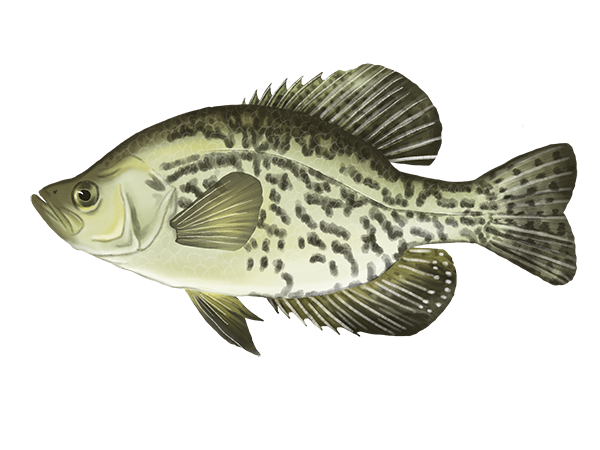
Body Type & Identification: Silver-white with irregular black speckles and spots randomly distributed across the body — more scattered and irregular than White Crappie's vertical barring. Seven or eight dorsal spines (White Crappie has five or six). Prefers clearer, cleaner water than White Crappie. The most popular panfish in the US alongside Bluegill.
Preferred Water Temperature: 65°F–75°F. Spawn in spring when water reaches 62°F–68°F in shallow, weedy areas. Form large, accessible schools in spring near spawning areas — the most productive crappie fishing of the year.
Habitat: Clear lakes, reservoirs, and slow rivers with aquatic vegetation. Associate with submerged timber, dock pilings, brushpiles, and aquatic weeds. Found throughout the eastern two-thirds of the US and widely introduced. Prefer clearer water than White Crappie — common in highland reservoirs and natural lakes.
Best Lures: Small tube jigs (1/16–1/8 oz) in chartreuse, white, and pink are the classic crappie lure. Small Beetle Spins and Road Runners produce consistent results. Tiny swimbaits on light jigheads. Spider rigging (multiple rods fishing multiple depths simultaneously) around brush piles is a highly productive technique.
Best Baits: Small live minnows (2–3 inches) are the top natural bait — hooked through the lips under a slip float at the right depth. Small nightcrawler pieces produce well. Wax worms work in cooler water. Light spinning or spin-casting tackle (4–8 lb line) with small hooks is standard.
Top 5 Destinations: Weiss Lake AL, Grenada Lake MS, Lake of the Ozarks MO, Santee Cooper SC, Reelfoot Lake TN.
Silver-white with irregular black speckles and spots randomly distributed across the body — more scattered and irregular than White Crappie's vertical barring. Seven or eight dorsal spines (White Crappie has five or six). Prefers clearer, cleaner water than White Crappie. The most popular panfish in the US alongside Bluegill.
Habitat
4 of 9
Clear lakes, reservoirs, and slow rivers with aquatic vegetation. Associate with submerged timber, dock pilings, brushpiles, and aquatic weeds. Found throughout the eastern two-thirds of the US and widely introduced. Prefer clearer water than White Crappie — common in highland reservoirs and natural lakes.
Water Conditions
5 of 9
65°F–75°F. Spawn in spring when water reaches 62°F–68°F in shallow, weedy areas. Form large, accessible schools in spring near spawning areas — the most productive crappie fishing of the year.
Tackle & Bait
6 of 9
Best Lures:
Small tube jigs (1/16–1/8 oz) in chartreuse, white, and pink are the classic crappie lure. Small Beetle Spins and Road Runners produce consistent results. Tiny swimbaits on light jigheads. Spider rigging (multiple rods fishing multiple depths simultaneously) around brush piles is a highly productive technique.
Best Baits:
Small live minnows (2–3 inches) are the top natural bait — hooked through the lips under a slip float at the right depth. Small nightcrawler pieces produce well. Wax worms work in cooler water. Light spinning or spin-casting tackle (4–8 lb line) with small hooks is standard.
Top Fishing Locations
7 of 9
Filter by State:
60 fishing locations where you can catch Black Crappie